
Uncovered! Why Do We Often Forget People’s Names? The Scientific Explanation Will Blow Your Mind!

Hello Fact Fans! Have you ever experienced that awkward moment where you recognize a familiar face, but their name has completely vanished from your memory? Or perhaps, you’re enjoying a conversation with a new acquaintance, and moments later, their name mysteriously disappears? This phenomenon of why we forget people’s names is a common, often frustrating, small mystery of daily life. Rest assured, you are not alone! Almost everyone has experienced this ‘tip-of-the-tongue’ sensation.
Why does our sophisticated brain sometimes ‘hide’ names, even when we are certain we’ve heard them? Is it a sign of early forgetfulness? Or are there more fascinating, scientific explanations at play? Today, we will thoroughly explore seven scientific explanations why we forget people’s names that you might have wondered about. Let’s delve deeper into how our memory works and uncover the secrets behind this common occurrence. Are you ready to become an impromptu memory detective? Let’s embark on this intriguing journey to understand why we forget people’s names!
7 Scientific Explanations Why We Forget People’s Names You Need to Know
1. The ‘Tip-of-the-Tongue’ (TOT) Phenomenon: You Know It, But Can’t Say It!
Fact Fans, this sensation is surely very familiar, isn’t it? You know the name, it feels like it’s right ‘on the tip of your tongue,’ but for some reason, you just can’t articulate it! This is precisely what we call the ‘Tip-of-the-Tongue’ (TOT) phenomenon. It’s one of the most common reasons why we forget people’s names. Scientifically, TOT occurs due to a ‘gap’ or discrepancy between semantic memory (the conceptual information about the person) and phonological memory (the sound or lexical form of the name itself). Our brain successfully accesses some information about the person—like their face, the context of the meeting, or even some specific details—but fails to ‘retrieve’ the complete name. It’s much like trying to grab your favorite snack from a transparent jar; you can see it, you know where it is, but your hand just can’t quite reach it! This feeling is truly exasperating, isn’t it? This phenomenon highlights the complex retrieval processes within our memory. For more information on memory phenomena, you can consult Psychology Today’s memory articles.



2. Cognitive Load: Our Brains Are Multitasking (and Sometimes Overloaded)!
Just imagine, our brain is like a supercomputer running many applications simultaneously. When we meet a new person, the brain has to work incredibly hard. It needs to process many things at once: recognizing faces, listening to names, processing voices, understanding the conversation context, and even forming a first impression. All these processes demand substantial cognitive resources. If at that moment we are already busy thinking about other things, or the surrounding environment is very noisy and full of distractions, our brain’s capacity to ‘store’ a new name optimally will significantly decrease. This is akin to our brain’s RAM being full, making it difficult to perfectly save the ‘person’s name’ file. Therefore, if you are intensely focused on many things at once, it is quite normal to forget people’s names you’ve just met. Our brain has its own limits, you see! The explanation of cognitive load in memory is highly relevant here. You can read more about the theory of cognitive load.

3. ‘Decay Theory’: Memories Fade If Not Used
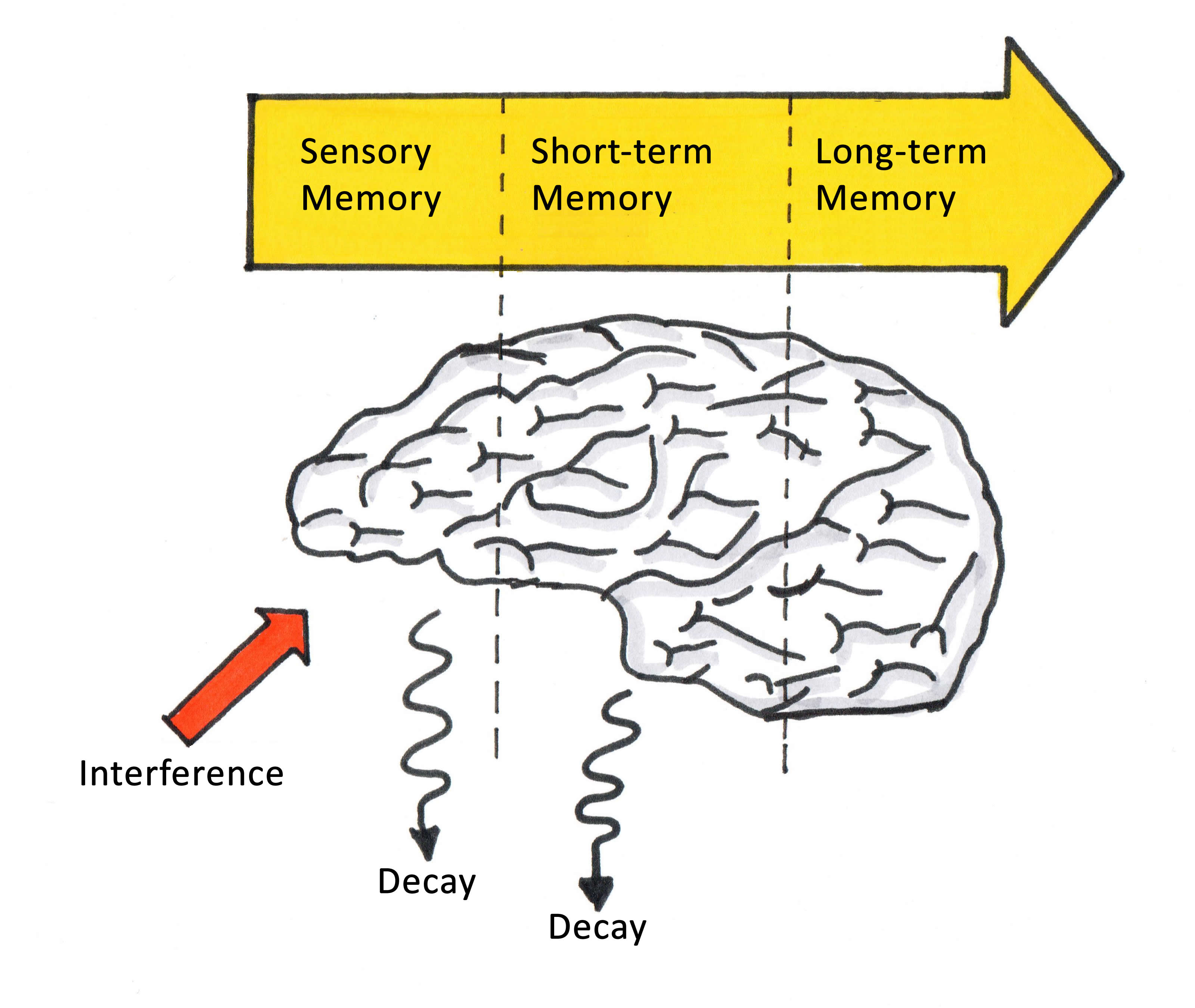
This theory is quite simple yet explains a great deal: memories that are not regularly rehearsed or accessed will naturally fade and weaken over time. A name we’ve just heard might only be stored briefly in our short-term memory. If we don’t immediately use it, say it aloud, or connect it with other stronger information, that memory can ‘expire’ and simply disappear from our recall. It’s comparable to food in the refrigerator; if it’s not cooked or consumed promptly, it will spoil and become unusable! So, don’t be surprised why we forget people’s names if we rarely interact with that person or seldom call them by their name. The process of memory strengthening requires regular ‘maintenance.’ To delve deeper into this theory, you can refer to an article on Decay Theory.

4. Proactive and Retroactive Interference: Memories Colliding!
Here are two primary ‘culprits’ in the world of memory that often cause considerable confusion. They are proactive interference and retroactive interference. Proactive interference occurs when our older memories (for example, the names of old friends or family members) actively ‘interfere’ with or hinder our ability to recall new information (such as the name of someone we’ve just met). Conversely, retroactive interference happens when new information or memories actually ‘overwrite’ or impair our ability to recall older information. So, imagine the names in our brain are like a long queue at a supermarket, constantly ‘jostling’ and competing for space. Because of these ‘memory clashes’ in our minds, it’s quite normal if we sometimes forget people’s names. Our brain tries to manage so much information that occasionally, small ‘short circuits’ occur. Learn more about these types of memory interference at Simply Psychology.
5. Lack of ‘Elaborative Rehearsal’: Superficial Retention, Not Deep Processing
To strongly and durably embed something into long-term memory, we need a process called ‘elaborative rehearsal.’ This isn’t just about rote repetition; it involves processing new information deeply and actively trying to connect it with existing knowledge or experiences in our minds. For instance, when hearing a new name, we might try to visualize the person’s face, repeat the name a few times while seeking similarities to other names, or even create a humorous acronym. If we merely hear a name fleetingly, without further effort to process, repeat, visualize, or associate it with something unique and meaningful, that name will very easily ‘bounce off’ and not ‘permeate’ into our long-term memory. Thus, when we only ‘listen’ without adequately ‘processing,’ forgetting people’s names becomes a very natural occurrence. The importance of elaborative rehearsal in memory is explained in numerous sources. You can read about this at the Exploratorium.

6. Stress and Lack of Sleep: Our Memory’s Arch-Nemesis!
Believe it or not, stress and insufficient sleep—two things we often underestimate amidst the hustle and bustle of modern life—play a significant role in making us forgetful, including forgetting people’s names! When we are stressed, our body releases the hormone cortisol. This hormone, in excess, can impair the function of the hippocampus, a brain region absolutely crucial for the formation of new memories. So, when stress strikes, our brain becomes ‘reluctant’ to store new names. The same goes for lack of sleep; our brain doesn’t have enough time and opportunity to perform ‘memory consolidation’—the process of ‘strengthening’ newly formed memories from short-term to long-term storage. So, Fact Fans, if you frequently forget names or other important things, take a moment to check your sleep patterns and stress levels! This might be a signal from your brain asking for a rest. For more on the impact of stress on memory, you can check this Harvard Health article.

7. Natural Aging Process: Our Brains Evolve Over Time
As we age, our brain’s ability to store and retrieve information naturally experiences a slight decline. This is an unavoidable part of the aging process, where neural connections in the brain can weaken, and the speed of information processing slows down. This does not imply that someone is becoming senile in the sense of a dementia disease, but rather a normal and expected decline in cognitive function. This process can make it harder for us to recall new names or require more time to retrieve them from memory. So, Fact Fans, if your grandparents or older relatives often forget names, please don’t scold them! It doesn’t mean they are absentminded or senile, but rather it’s part of the brain’s natural journey of change. Offering understanding and patience will be very helpful. This is one of the most fundamental scientific explanations why we forget people’s names. Further information on aging and memory can be found at the National Institute on Aging.

The Meaning Behind Forgetfulness: A Reflection on Our Memory
Well, Fact Fans, it turns out there are many scientific explanations behind the simple phenomenon of why we forget people’s names. From the frustrating ‘tip-of-the-tongue’ phenomenon to the impacts of stress, lack of sleep, and the inevitable natural aging process. Ultimately, our brain is an incredibly complex organ that sometimes has its own ways of filtering, storing, and retrieving information. Forgetfulness, including forgetting names, is not a fatal flaw. Instead, it is often just a signal from our brain that might be ‘overloaded,’ needs rest, or requires a more effective memory strategy.
Understanding why we forget people’s names teaches us to be more patient with ourselves and with others. It’s not a matter of being lazy to remember, but rather the dynamic workings of memory. Instead of blaming ourselves or others, let’s try to train our memory smarter: pay full attention when meeting new people, repeat their names, associate them with something unique, and most importantly, take care of our physical and mental health. Every name holds its own unique story. With a little effort and understanding, we can keep the ‘library’ of names in our brain organized and easily accessible. Keep exploring fascinating facts and visit DepoTopic.com for more intriguing information!
Do you have an idea for creating an attractive and informative WordPress-based website like this one? Don’t hesitate to Contact Us. We are ready to help turn your ideas into a professional website ready to compete in the digital world!


