
EU AI-Generated Content Labeling Rules: What Changes in August 2026
Inside Article 50 of the EU AI Act — the deepfake disclosure law arriving this August, and what it actually changes for everyday readers

Somewhere in Europe this week, someone watched a video of a public figure saying something outrageous, felt a jolt of outrage or disbelief, and shared it before checking whether it was real. It happens daily now — a synthetic clip of a celebrity “endorsing” a product, a fabricated clip of a politician, an AI-generated voice memo from someone who never recorded it. Starting August 2, 2026, the EU AI Act’s AI-generated content labeling rules are supposed to change that experience, at least for the content created and shared professionally within the EU’s reach. This isn’t a proposal anymore. It’s a binding transparency law under Article 50 of the AI Act, and it’s about to reshape what a label, icon, or disclaimer next to a photo, video, or voice clip actually means.
This piece breaks down what the EU’s AI-generated content labeling rules actually require, what they conveniently leave out, and — more usefully — what it means for you as someone scrolling, sharing, and trying to tell what’s real in an increasingly synthetic media landscape.
What the EU AI-Generated Content Labeling Rules Actually Say
Article 50 of Regulation (EU) 2024/1689 — the EU AI Act — has technically been on the books since 2024, but it only becomes enforceable on August 2, 2026. It creates four separate transparency duties, and it’s worth knowing the difference because they land on different people. According to legal analysis of the rule, the law requires that AI systems interacting directly with people identify themselves as machines, that generative AI providers mark their outputs as machine-detectable, and that anyone deploying AI to create realistic deepfakes disclose that clearly to a human audience.
That last piece — the deepfake labeling duty — is the one most people will actually notice. A deepfake, under the Act’s legal definition, is AI-generated or manipulated image, audio, or video content that resembles a real person, object, place, or event closely enough that someone could mistake it for genuine. Crucially, draft European Commission guidelines clarify that intent doesn’t matter here. Content that looks or sounds like a real person has to be labeled even if nobody meant to deceive anyone with it.

Why the August Deadline Is Landing Now — and Why It’s Not Really “New”
The EU AI Act itself dates back to 2024, and its rollout has always happened in phases: banned practices and AI-literacy duties arrived first, back in early 2025, followed by general-purpose model rules later that year. The transparency and deepfake labeling piece was always scheduled for August 2026 — what’s changed recently is that the practical rulebook for it has finally taken shape. The European Commission published draft guidelines on May 8, 2026, clarifying exactly what counts as a deepfake and what counts as adequate disclosure, and a voluntary Code of Practice on Transparency of AI-Generated Content has gone through multiple drafts since December 2025, with a final version expected shortly before enforcement begins.
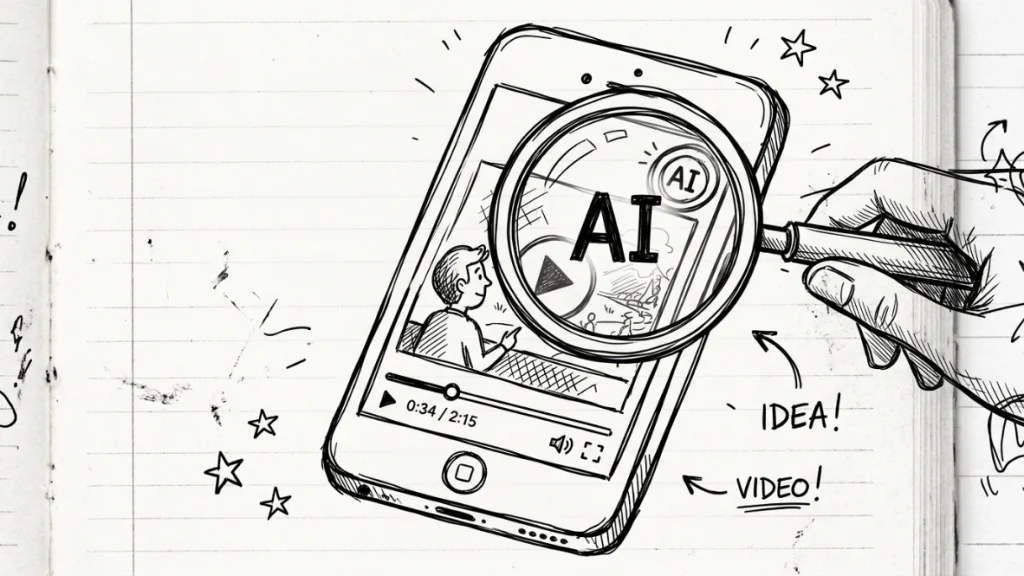
That Code matters more than its “voluntary” label suggests. It proposes a standardized visual cue — likely a simple “AI” icon, localized as “KI” in German or “IA” in French and Spanish — that would appear consistently across platforms. Legal commentary on the draft code notes that companies who don’t adopt it face heavier scrutiny from regulators, which is a strong incentive to fall in line even without a legal mandate to do so. Fines for non-compliance with the transparency rules can reach €15 million or 3% of a company’s global annual turnover, whichever is higher — enough to get any social platform’s or media company’s attention.
What You’ll Actually Start Seeing on Your Feed
If the rules work as designed, the difference will show up in small but specific ways. Images with realistic AI-generated people or events should carry a persistent, visible icon rather than a watermark buried in file metadata you’d never see. Video is expected to show an opening disclaimer plus a persistent on-screen marker throughout, not just a flash at the start that’s easy to miss. Audio-only deepfakes — AI-cloned voices, for instance — are expected to include an audible disclaimer, repeated for longer clips.
The draft guidelines are notably blunt about what does not count as compliant disclosure. A reference buried in the terms and conditions doesn’t satisfy the rule, and neither does a vague label like “assistant” or a technical note that a system “uses LLMs.” Regulators want disclosure that a normal person would actually register the moment they encounter the content — not something a company can point to later and claim they technically mentioned it.

The Honest Assessment: What This Law Won’t Fix
Here’s where a healthy dose of skepticism belongs. The AI-generated content labeling rules under Article 50 are genuinely significant, but they are not a universal deepfake shield, and treating them as one would be a mistake.
- The duty falls on “deployers acting in a professional capacity,” not on random individuals. A private citizen who generates a synthetic image for personal use, a meme, or a joke among friends generally isn’t the target of this law the way a media company, marketer, or platform is.
- Artistic, satirical, and fictional works get a lighter touch. A parody video or an obviously fictional AI-generated scene only needs minimal, non-intrusive disclosure — which leaves plenty of room for interpretation about what counts as “obviously” fictional.
- The Code of Practice is voluntary. Companies that skip it can still claim compliance through alternative means, which means enforcement in the early months will likely be uneven across the EU’s 27 member states.
- It only reaches content tied to the EU market. A US-based platform or creator whose content never reaches EU users isn’t obligated to label anything under this law — which is exactly why a widely shared, professionally distributed AI-generated video of a public figure making fabricated statements, of the kind that circulated on social media in July 2026, illustrates the gap: labeling rules were not yet enforceable, and even once they are, jurisdiction and platform-level enforcement remain genuinely complicated questions.
There’s also a structural tension worth naming honestly: the EU’s own “Digital Omnibus” simplification package, moving through negotiations in parallel, has floated pushing back some of the marking obligations for generative AI providers to December 2026 for systems already on the market. Regulation and simplification are pulling in slightly different directions at the exact moment the rules are supposed to bite, which is a genuinely unresolved tension rather than a settled fact.
What This Actually Means for You
For everyday readers in Europe — and, practically speaking, anywhere given how much content crosses borders — the AI-generated content labeling rules are worth understanding on their own terms rather than as a magic fix. A few concrete takeaways:
- Don’t treat “unlabeled” as proof of authenticity. The absence of an AI label doesn’t confirm something is real; it might mean the content predates enforcement, originated outside the EU’s reach, or fell into one of the law’s carve-outs.
- Learn to recognize the coming icon. Once the standardized “AI” (or “KI,” “IA”) marker rolls out across platforms later in 2026, it will become a genuinely useful, at-a-glance signal — but only if you know to look for it.
- Treat viral, emotionally charged clips of public figures with extra caution regardless of labeling, especially around elections or breaking news, where synthetic content tends to spread fastest and labeling enforcement lags furthest behind.
- Watch how platforms you already use respond. Expect major platforms to start rolling out AI labeling features and detection tools in the coming weeks as the deadline approaches, since noncompliance risk now carries real financial teeth.
Reading the Fine Print Behind the Label
The EU AI-generated content labeling rules represent the first real attempt by a major regulator to force disclosure into the moment people actually encounter synthetic media, rather than burying it in policy documents nobody reads. That’s a meaningful shift, even with its gaps. The honest takeaway is that August 2026 won’t suddenly make every deepfake obvious — but it will make deliberate concealment legally riskier for the companies and professionals who create and distribute this content at scale.
For the next several months, expect a messy, uneven rollout: some platforms moving fast to adopt the Code of Practice’s icon, others waiting to see how strictly regulators actually enforce it, and ongoing debate over the Digital Omnibus timeline. Watching how that plays out will tell you a lot about how seriously “AI transparency” gets taken once it stops being a policy document and starts being a line item in a compliance budget.
Sources & References
This article draws on legal and regulatory reporting from Bratby Law, Greenberg Traurig LLP, Jones Day, and the EU AI Act’s official explainer resource.
